|
Why I'm still not
selling the new version Whirlpool
#285753A direct-drive washer coupler, with steel inserts
Great News! As of
mid-2013, Whirlpool has corrected the problems listed below, and
I'm happy to report these couplers (OEM genuine Whirlpools only) are working well now!
Thanks, Whirlpool! In stock
HERE
(Link directs to Ebay, the best place to buy appliance parts
these days) |
Here's what I originally wrote on the subject,
when the issues were major and not getting fixed:
I've been getting a lot of questions lately about why I don't sell
Whirlpool's new version
coupler (#285753A) for their direct-drive washers (sadly, this excellent washer
is no longer
being manufactured).
This latest version coupler has steel inserts imbedded in its 2 plastic
sections, the idea being
to make it more reliable. I'm afraid this hasn't been the case in practice, so
I've avoided this
one, and will continue to do so unless it's improved. It looks like this:
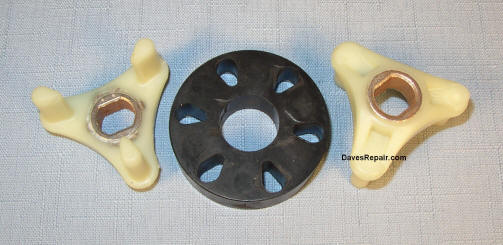
I have two reasons for this. First, they are so tight and hard to drive
onto the gearcase and
motor shafts, it's hard to install one without damaging the shafts. And because
they are so
tight, removal when they do break can also be very difficult.
Secondly, we're starting to see them stripping/rounding off the drive
flats on motor shafts,
ruining motors - and that's unacceptable! The idea behind any drive 'weak
link' - belt, coupler,
etc - is to slip or sacrificially fail when something goes horribly wrong, to
keep from ruining
something more major and expensive.
Having to replace an expensive main drive motor due to a $10 drive coupler
failure tells us
there's a major problem with this coupler design.
If you've been reading this newsletter for very long (God bless you for
enduring my rambling!),
you've heard me 'preach' about the brake lockup issue in these washers (it's
easy to fix),
and the damage it does to couplers. I'm pretty sure - haven't proven it yet -
that most of the
motor shaft failures we're seeing from these steel couplers start out as simple
brake lockup.
One of my fears with this issue is that Whirlpool won't make any
improvements on it now
since they've stopped building these machines. Even though there are many
millions of them
still in daily use (we just bought the last new one we could find, and also have a
spare!), it may
not
be cost effective for the company to make the necessary tooling changes to these
couplers.
'Sure hope I'm wrong about this, and I may well be. Whirlpool is usually
on top of these kinds
of problems. However, I remember telling Whirlpool reps about the brake lockup
issue and
submitting a suggestion for solving it, some 15 years ago, with no change
to date. Frustrating.
Anyway, I hope that helps explain why I'm still using and selling the
non-steel version of the
coupler. Keep those brakes lubed,
folks!
Was this article helpful?
Please click the "donate" button on the left side of
this page to help me keep this information free!
Many Thanks! - Dave
Copyright
www.DavesRepair.com
This article may be reprinted and distributed freely only
in its entirety, including this message.
|