|
The DRSNews
August
2008
Published by 'double opt-in' subscription only,
by Dave's Repair Service, (c)2008 All Rights Reserved
WHO ELSE WOULD LIKE THIS NEWSLETTER?
If you enjoy this issue, you're welcome to forward its link
to any friends or associates who might find it useful.
(There's an unsubscribe link in every issue if they decide
it's not their 'thing') Thanks!
***************************************
A Special 'Welcome' to my new subscribers! Glad to have you
aboard!
In this issue:
1) Window
Air Conditioners: Cleaning & Basic Diagnostics
2) The Glossary of Appliance Terms
1)
Up here in the mountains of NE PA, our short air conditioning season is
about over. I think we ran ours less than 10 times this summer, so it
should
last a while.
There's always a tinge of sadness to mid-August as I
watch the Hummingbirds
leave, because I get a real kick out of the little critters. I'm down to
feeding
just a quart of sugar water every day, so evidently they're starting to
trickle
south.
Anyway, I wanted to talk to you about window air
conditioning a month or
two ago, but with the 'busyness demon' running rampant at our house
lately,
here I am, late again! Oh well, it might still be a good time to cover
some
quick tips on the subject. I know a lot of you guys're in the South, and
are definitely not through the worst of the HHH time of year yet.
Seems every year we have 2 or 3 'handy' guys that,
like me, just have
to 'modify' the stuff they buy. They hear water sloshing around inside
their
brand new window air conditioner, and say, 'well, that can't be right',
and
promptly drill a drain hole up through the bottom.
By the time the hissing noise starts it's way past
too late, and the AC is
trashed, because, you guessed it, the drill bit has poked a hole in the
refrigeration system tubing, and now we have a major leaker! The short
answer is: don't do it! Let it 'slosh'!
Modern window air conditioning units are designed to
wring as much
efficiency from their systems as possible, and part of that design uses
a base pan without a drain hole like older models, and evaporative
cooling to help transfer heat.
There's always a bit of water allowed to lie in the
pan, and the condenser
fan blade's designed to throw that water - actually the humidity that's
been removed from the room - against the coil, cooling it. This raises
efficiency, and allows a smaller coil to be used. It's another reason
window
units have shrunk in physical size so dramatically in the past decade or
so.
(OK, it's also another reason they don't last as
long, with all the rusting
and corrosion taking place - but that's another story. <grin>)
When it comes to checking the expensive stuff in one
of these units, it's
basically the same technique used in refrigerators and freezers. We've
talked about this many times before over the years, but window AC's
have their own 'built-in diagnostic tool', just like your refrigerator.
If you have any doubts about the system's integrity,
and you know its
coils are clean, especially on the inside of the condenser (hot) coil,
then
the condensation pattern will tell you whether everything's OK or not.
On refrigerators, we call it the 'frost pattern' on
the evaporator (cold)
coil, but we don't want actual frost on an AC coil, but do want to see
condensation (if you run one through the night and the temperature falls
into the 50's, there's a pretty good chance it'll frost over completely,
which is normal).
The test is the same, though: if that pattern of
moisture's evenly covering
the coil after it's been running a while, say an hour or so, all's well,
and
it's doing all it can. If only part of the coil is wet, and/or there's a
portion
that has frost on it, then we're probably looking at a serious problem.
A really dirty condenser coil can cause these kinds
of symptoms in small
AC units, too. So one of the first things, and kindest things, you can
do
for your unit, is to take it apart every couple of years and hose it
out.
It can be hard to see, but pay especially close attention to the inside
of
the condenser coil, between the fan blade and coil.
They make chemicals for the purpose, but high
pressure water can
also do a good job of blasting this 'crud' (a highly technical term, not
found in my dictionary ;-) ) out of the coil.
If everything's clean but the condensation pattern's
still not even, it
may be time to scrap the unit. It pains me to say that, but with the
price
of new window AC these days and the expense of system work, it
usually doesn't pay to recharge them any more.
Years ago we also would've discussed oiling the fan
motor as a part of
routine maintenance, but with today's 'permanently' lubricated motors
having no provision for that, we'll skip it. [sigh]
One other tip , and then I'll wind this up. It's
really easy to damage AC
coils when moving or installing them. If either coil has many of its
fins
kinked or bent, it can affect efficiency, so I straighten them when I
see
any damage.
One or two damaged fins isn't a big deal, but with
airflow so critical on
newer HE designs, if there's much surface area flattened, they should
be straightened, or 'combed'.
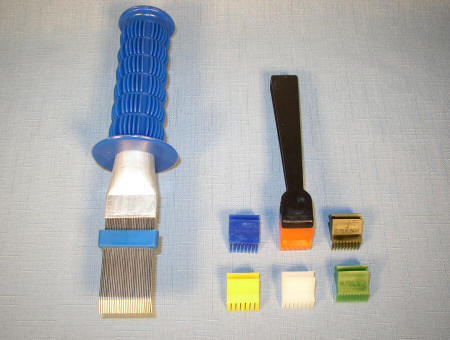
There are several ways to do that, including a
standard wire brush, but
I prefer the tools made for the purpose, because they just do a better
job.
Here's a photo of two styles of 'fin combs'. Both are
adjustable, with
steel ones a lot tougher than the plastic versions, but they both do a
passable job:
That's about all I have room for on the subject this
month. If you've
come across any interesting twists on any of this, please let me know.
Thanks!
2) I'm finally about done with this project, and would love your opinion.
The text portions are finished, even though it's a work in
progress.
I call it a 'glossary of appliance terms', and have nearly all of the
illustrations added. And it'll be available as one downloadable
pdf file
when I get it 'tweaked'. That's where you come in:
Please let me know what you think when you get a chance. Any ideas
you have for improvements, changes, more ease of use, terms you'd
like to see added, etc, are welcome. Here's what I have so far:
Glossary
There's been a lot of demand for something like this; sort of an
abridged 'encyclopedia' of terms used in appliance service every
day. I tend to assume that everyone knows what I'm talking
about, but it can get confusing. This project is an attempt to list
common (and not so common) words and phrases used in the
profession.
Thanks again for inviting me into your inbox.
I don't take the invitation
lightly!
As always, if you have any topics you'd like to see discussed here
or covered in an online article, let me know and I'll do my best to
oblige. And don't forget those testimonials! Many thanks to those
of you who've already sent yours in!
May God richly bless you and yours,
and may He continue to have
mercy on America!
Warmly,
Dave Harnish
Dave's Repair Service
New Albany, PA
drs@sosbbs.com
www.DavesRepair.com
We could learn a lot from crayons ... Some are sharp, some are
pretty,
and some are dull. Some have weird names, and all are different colors,
but they all have to live in the same box.
Acts 17:26
(Most) Back Issues:
www.DavesRepair.com/DRSNbackissues
Copyright
www.DavesRepair.com
All Rights Reserved
This information may be reprinted and distributed freely, but
only in its entirety, including this message.
|